

Three Lives. One Answer.
Last night at a Stanford community talk, I saw the full arc of where we're headed through the eyes and voice of a man who has been privileged to live it through fifty years of storytelling.
Kunta Kinte was nineteen years old when LeVar Burton played him. Reading Rainbow premiered when he was twenty-six. Geordi La Forge came nine years after that. Three characters, three decades, three entirely different stories about what a human being is for. The fact that one man inhabited all three in that sequence isn’t a coincidence; it’s evidence.
Beyond Work has been examining the question of “what happens to human value when machines can do what we’ve always been paid to do?” — and it appears to have already been answered over the course of decades of Burton’s creative work.
The First Life: Labor as the Container for Value
Kunta Kinte’s world was built on a single premise: that a human being’s worth lives in what their body can produce. The institution of slavery is the Labor Economy made absolute. Strip away the legal and moral architecture of employment and what remains is the same core transaction: your value is measured by your output, your compliance, your capacity to serve the system’s needs. Kunta Kinte refused… at every cost, and at every turn, he refused.
What Burton did in Roots wasn’t acting: he bore witness. He carried Kunta Kinte’s refusal – the refusal to surrender a name, an identity, a sense of being, through eight nights of television at a moment when America had no framework for what it was about to experience. Before Roots, the national conversation about slavery had reduced it to an economic system. After Roots, it couldn’t unsee what it now knew. The institution now had a human face, and America could never be the same.
At its most consequential, storytelling doesn’t deliver information as much as it resets the container that holds it. Burton was nineteen years old and scared of being wrong, and he had learned from his Aunt Hope to say the word anyway. He brought that lesson to Kunta Kinte’s body and let it do its work.
The struggle in Roots was the argument itself, not a background to it. Suffering without surrender makes a specific claim about human dignity, and that claim traveled through the coldest winter in recorded history into the living rooms of people who’d never been asked to consider it before then. What Roots established, for millions of people who weren’t ready for the conversation, is that human value was never in the output. It was always in the identity that no system could own.
The Second Life: Imagination as the Path to Agency
Reading Rainbow debuted in 1983 with no money, no leverage, and no publishing support. Burton described the early seasons as “fraught with scarcity.” He was begging for resources, fighting for airtime, making the case to anyone who would listen that children’s access to literature was worth a summer afternoon on public television.
What changed was Data. When the research arrived showing how many children were tuning in, and when publishers discovered that books featured on the show were selling at higher rates than expected or planned, then suddenly everyone wanted to be part of what he was doing. Large publishing houses were waiting at the door, and the show that had been begging for books became a hot ticket for everyone.
Burton’s description of that shift was humble, almost offhand, but the structure that caused the shift is the real story. He’d built an audience nobody else was building by taking children who could read and turning them into readers for life. The difference between those two categories is freedom. A child who reads is capable, but a child who reads for life answers to no one’s ceiling.
This is the distinction that matters in the transition we’re living through now. The capable reader is the worker: competent, functional, valuable within a defined system. The reader for life is an autonomous contributor: self-directing, self-educating, able to generate meaning instead of just executing tasks. Reading Rainbow’s ambition was clear, they existed to move children from one category to the other. That’s the same move every organization will need to make with its people in the next few years.
LaVar held his ground on something else, too. When the show’s producers objected to his pierced ear, he said “you hired me” and refused to become what they wanted to make a portion of the audience comfortable. He unknowingly became what children like Jason Reynolds needed to see, which was a Black man in full, present every week, comfortable in his own body and his own mind, talking to kids about books. That’s authenticity about representation, and it doesn’t require you to be anyone else to make it work.
The Third Life: The Human at the Center of the Machine
Geordi La Forge couldn’t see without technology. His VISOR gave him a range of perception no unaugmented human possessed, but it also meant he moved through the world differently than everyone else in the room. He lived at the intersection of human limitation and technological extension. That's exactly where we all live now, and almost none of us has thought carefully about what it requires of us.
His relationship with Data is the arc that matters most for this moment. Data was an android with vast knowledge, no feeling, and no comprehension of what it meant to experience joy or grief or friendship. The relationship turned out to be generative instead of charitable, and it ran in both directions. Data became more human by staying close to someone who modeled what it looked like to be one, and Geordi became more capable by staying close to someone who could compute what he couldn’t.
What they built together is the relationship structure we’re still searching for language to describe: genuine collaboration between a human and a nonhuman intelligence, each extending the other’s capacity without replacing it. Stanford’s provost cited the Geordi-Data friendship in her closing remarks last night as the most relevant frame for thinking about AI and education right now. She was right that the relationship’s power came not from Data becoming human, but from Geordi remaining fully one.
This is the model organizations don’t yet have. They’re building AI integrations, automation workflows, and efficiency gains. What they’re not building is the condition for Geordi: the human being who brings themselves fully to the relationship with machine intelligence and is strengthened by it rather than displaced. You can’t build that condition by optimizing for output. You can only build it by first deciding that the human contribution is irreducible.
What the Arc Shows Us
Separately, these three lives look like a career. Together, they make one bold statement.
The pressure on Kunta Kinte was designed to erase who he was… and it didn’t. The access Reading Rainbow gave to children’s imaginations couldn’t be undone once it took root. And Geordi’s friendship with Data demonstrated that technology extends human capacity without replacing it, provided the human brings themselves fully to the relationship.
Burton didn’t plan this arc; he followed the signposts. He trusted himself at the moment his aunt told him to say the word, refused to let them reshape him over an earring, and showed up to lunch with Gene Roddenberry only to discover that the spiritual depth he’d found in Star Trek was, according to its creator, not there at all. Roddenberry was an agnostic who built an egalitarian universe and insisted he’d put nothing spiritual in it. Burton concluded it was in the eye of the beholder; he found it anyway.
The meaning was never located in the author’s intention. It lived in the reader’s act of finding it. This is what Burton has been arguing across his entire life, in every medium he’s touched. The human being is the meaning-maker. The page, the screen, the android, the VISOR: these are instruments, and the instrument doesn’t determine what gets built.
The Mandate This Moment Requires
The incentive mismatch right now is that we’re building AI faster than we’re building the human imagination structures required to work with it well. The organizational cost is a generation of workers whose capacity for deep attention is being traded for the frictionless engagement of systems designed to consume instead of to develop. The behavioral adaptation required of anyone in a leadership position is to hold the line on what it means to be the human in the room: present, curious, capable of stillness, willing to say the word even when you’re afraid of being wrong.
Burton sat in front of a Stanford audience last night and told a room full of pre-service teachers that the most powerful technology in the world is words on a printed page. I understood why when the audience applauded. It wasn’t a rejection of AI; it was acknowledgment of where the generative capacity lives, and that claim is the same one he’s been making since he carried Kunta Kinte’s refusal onto a screen when I was just seven years old.
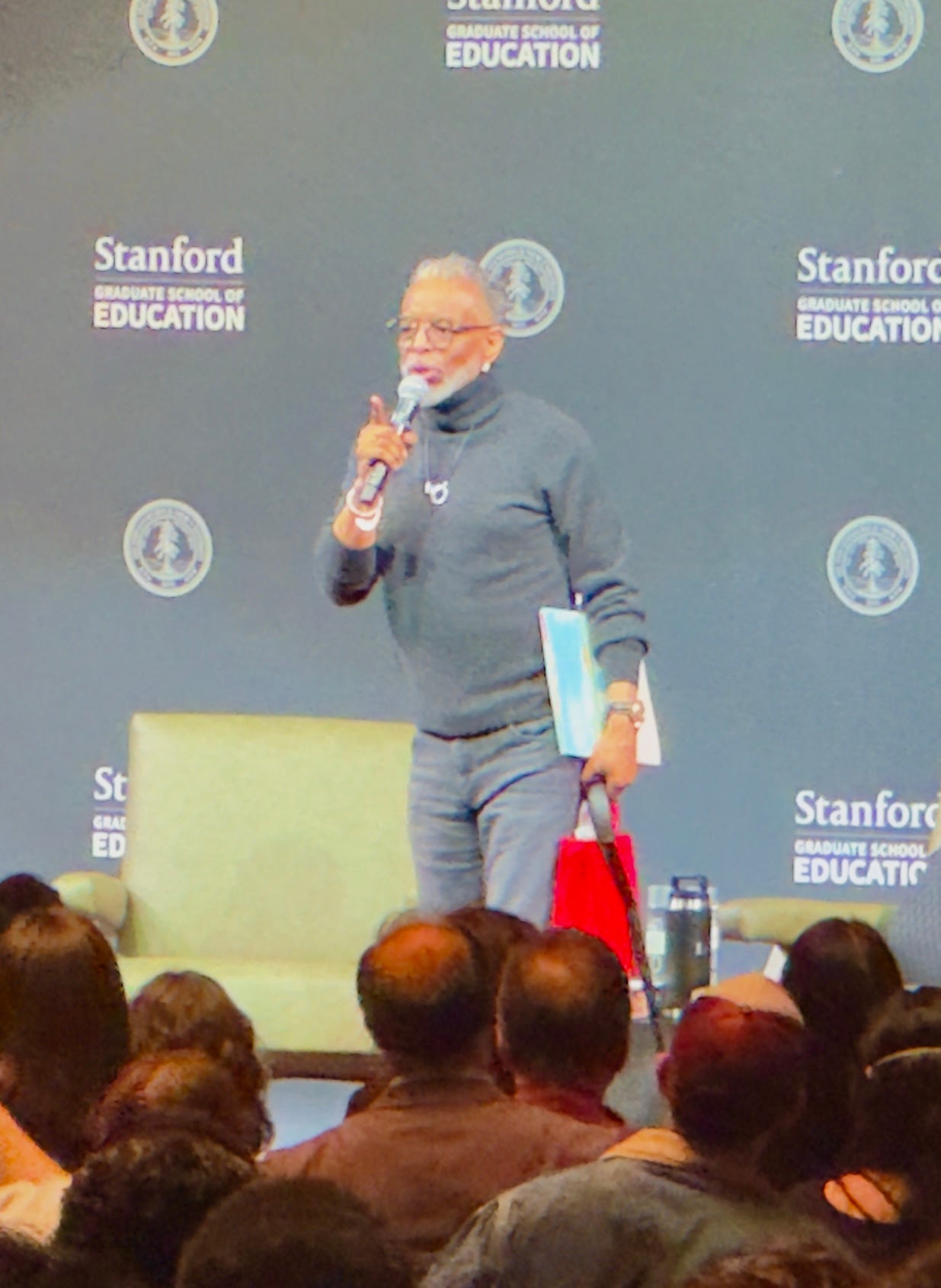
He also said that human beings are manifesting machines, and that we do it unconsciously all the time. He asserted that we should start doing it on purpose. This isn’t inspiration, it’s a design principle. The organizations that understand human contribution as an act of imagination rather than a unit of production are the ones building for what’s actually coming. The ones that don’t are optimizing for a version of work that’s already leaving.
The mandate is human, not technological. Burton knew Kunta Kinte’s name and refused to let it be replaced. He knew that Geordi’s limitation was inseparable from his power. And he knew, from the moment his aunt waited him out over a single word, that the page is where the reader becomes the director. None of it was accidental. All of it was chosen.
We have the same choice. The arc is already there. The question is whether we intend to follow it.